
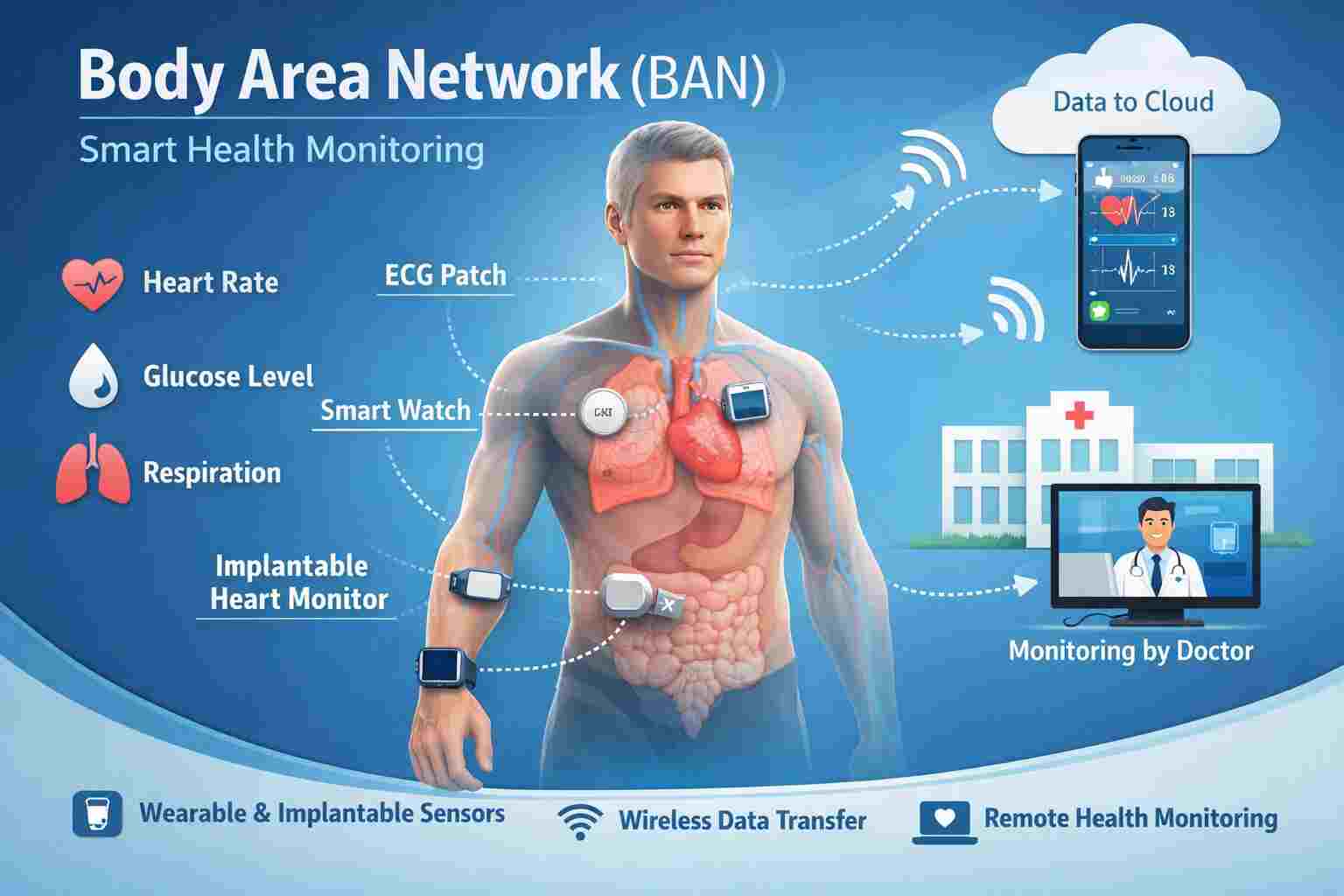
Imagine a small network of tiny devices that quietly sits on your body and keeps checking your heart, sugar level, breathing, and more — and sends this information to your doctor automatically.
This is not science fiction.
This is Body Area Network (BAN) technology.
BAN is one of the most exciting developments in digital healthcare. It is designed to help people stay healthy, detect problems early, and reduce hospital visits — all through smart wearable and implantable sensors.
Let’s understand it in simple words.
What is a Body Area Network (BAN)?
A Body Area Network (BAN) is a group of small medical sensors that are placed on or inside the human body. These sensors continuously collect health data and send it wirelessly to a phone, tablet, or hospital system.
Think of it like a mini Wi-Fi network on your body, made only for health monitoring.
Doctors and caregivers can check this data remotely and act quickly if something looks wrong.
What Can BAN Devices Monitor?
BAN devices can track many important body functions, such as:
Vital Signs
- Heart rate
- Blood pressure
- Body temperature
- Breathing rate
- Oxygen level (SpO₂)
- ECG (heart electrical signals)
Special Health Data
- Blood glucose (for diabetes)
- Brain signals (EEG)
- Body movement and fall detection
- Eye pressure
- Muscle activity
This makes BAN very useful for people with heart problems, diabetes, elderly care, and rehabilitation patients.
Where Are BAN Devices Placed on the Body?
BAN devices can be:
1. Non-Invasive (Worn Outside)
These are placed on the skin or in clothing.
Examples:
- Wristbands
- Chest patches
- Smart shirts
- Neck or ear sensors
They are painless and comfortable for daily use.
2. Implantable (Inside the Body)
Some BAN sensors are placed inside the body through a small medical procedure.
Examples:
- Pacemakers
- Implantable glucose sensors
- Smart drug-delivery chips
These are used when continuous, accurate monitoring is needed.
How Do BAN Devices Communicate?
The communication happens in two simple steps:
Step 1: Sensor to Phone
Each sensor sends data wirelessly (Bluetooth, Zigbee, NFC) to a central device, usually your smartphone.
Step 2: Phone to Doctor
Your phone sends this data to the hospital or cloud using the internet. Doctors can monitor your health from anywhere.
Key Features of BAN Technology
- Very small & lightweight – you barely feel them
- Low power consumption – long battery life
- Wireless connection – no wires or cables
- Real-time monitoring – instant health updates
- Secure data – encrypted medical information
- Accurate & reliable readings
Size, Weight & Power
| Feature | Typical BAN Device |
|---|---|
| Size | As small as a coin or patch |
| Weight | Very light, wearable all day |
| Power | Low-energy batteries or body-energy harvesting |
| Charging | Some last days or weeks |
Advantages of Body Area Networks
- 24/7 health monitoring
- Early detection of disease
- Fewer hospital visits
- Better care for elderly & chronic patients
- Remote doctor support
- Improved quality of life
Challenges & Limitations
- Limited battery life
- Wireless interference issues
- Data privacy concerns
- High development and approval cost
- Implant safety regulations
Present Status of BAN Technology
- Many wearable BAN devices are already in use
- Implantable BAN devices are in clinical trials
- Communication standards like IEEE 802.15.6 are already defined
- Research is improving battery life, security, and comfort
BAN is not a future dream — it is slowly becoming part of modern healthcare.
Final Thoughts
Body Area Networks will change how healthcare works — from hospital-based care to personal, continuous, and remote care.
In the coming years, BAN technology may become as common as smartphones — quietly watching over our health, every second.
FAQ
What is a Body Area Network (BAN)?
A BAN is a group of small wireless sensors placed on or inside the body to continuously monitor health data and send it to doctors.
Is BAN technology safe?
Non-invasive BAN devices are safe. Implantable ones are tested under strict medical regulations before approval.
Where is BAN used today?
BAN is used in heart monitoring, diabetes care, elderly tracking, fitness, and remote patient monitoring.
Is BAN available now?
Wearable BAN devices are already available. Implantable BAN devices are under clinical trials.
Leave a Reply